Joystick split trigger
PC joysticks aimed at the flight enthusiast crowd typically feature a dual-stage trigger. This is where a half-pull actuates one switch, while a full trigger-pull activates a second switch. On true aircraft, this would be coupled with actions that can be done sequentially. For example, 1 might get the A-10 Warthog barrels spinning, 2 might activate the firing.
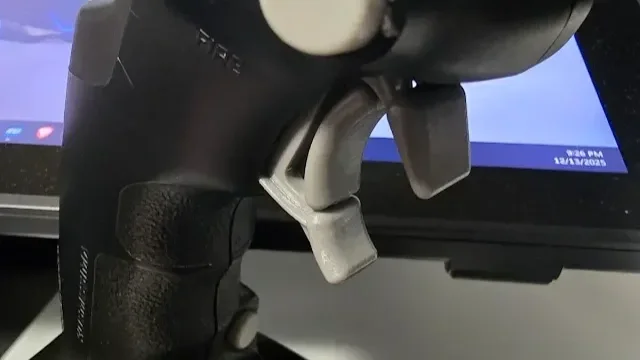
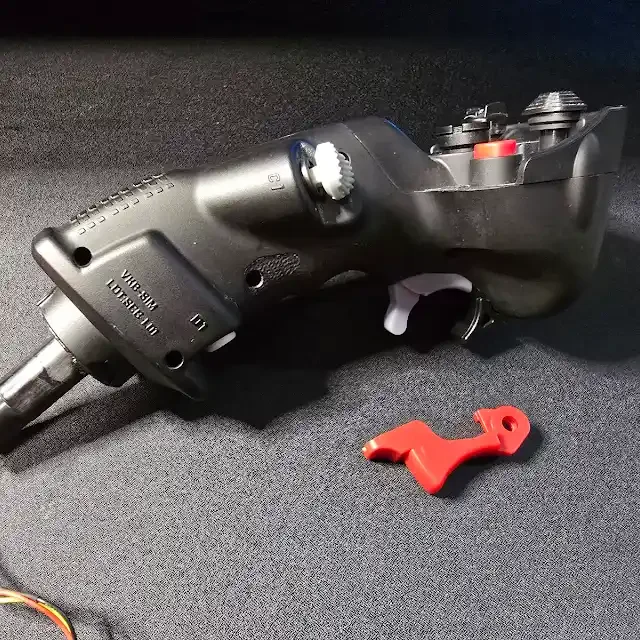
But games rarely take advantage of this
The second stage often goes unused because players struggle to find a use case where it makes sense to have the second switch dependent on what the 1st stage was doing.
That’s why I made the split trigger. The concept is simple, but like most things, easier said than done. I wanted to keep all the original functionality of being able to activate the 2 stages sequentially. But I also wanted a bypass to activate the 2nd stage independently.
The first version achieved this goal, but it wasn’t very comfortable. BUT, it proved the concept worked. I was able to activate the switches just as before, but now there was another dimension of control giving me direct access to that second stage.
These efforts generated a lot of buzz and I quickly came out with V2…
v2 made it big
The working principle was refined in V2 and a generous amount of time was taken to better mold the geometry to the fingers that would be using it.
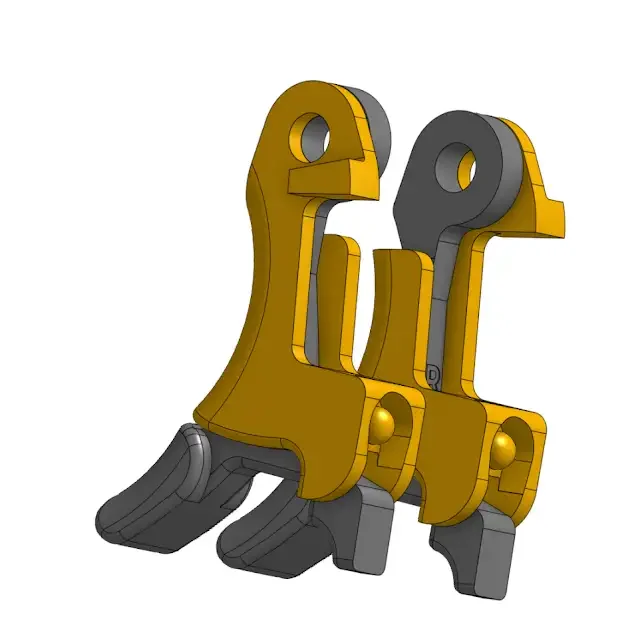
Originally, the joystick had a compression spring that sat between the plastic trigger paddle and the switch itself. The spring rested on the switch in such a way that as the spring was compressed, that compression would activate the switch at approximately half the throw of the trigger. I maintained that functionality with the wraparound nub shown here in the CAD image. The original stick had an extension of the trigger arm that would simply press the 2nd switch when pulled far enough. In my new design, that became a separate trigger arm that sat within the primary trigger (shown here in grey). It was held in the forward position by a 4mm spring that was sandwiched between the two stages.
Overall, V2 was a smashing success. The 3D print files were sold exclusively on Thangs and have generated over $1200 in sales at a very modest price of $10. Furthermore, other small businesses have been started solely on purchasing commercial licenses, also sold on thangs, with one such business generating enough revenue to buy the machines used to start the business.
Feel free to check the listing below for the most up to date metrics. As you can imagine, I’m quite proud of it.
Product Listing
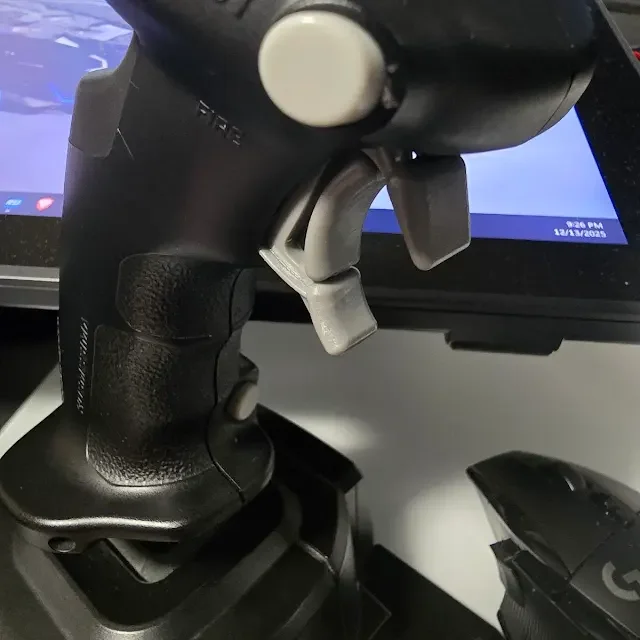
v3 perfects the idea
People clearly liked V2, which was the only one sold for profit up until now. Over the last year of using my own design, there were a couple things that I knew could be improved. So, that’s exactly what I set out to do with this 3rd iteration.
Because of the couple movement of the triggers, there was a lot of extra movement happening on the inside that made the tactile feel of the 1st stage feel mushy. It also placed a limit on the amount of space available for your fingers. If you had large hands, it could be uncomfortable to use V2.
V3 fixes all of this. It started with the realization that the movement didn’t need to be coupled at all. There was nothing wrong with having the 1st stage move separately, so long as it moved the 2nd stage when needed for activation. With this iteration, the 2nd stage is wedge between the front of the joystick casing and the button. It remains static until the 1st stage presses it into the button, or, the user does so themself. Since there’s no additional spring connecting the two stages, the 1st stage now moves independently through its throw. This fixes the tactile feeling and makes it much clearer to feel when the switch has been activated.
Not needing to accommodate an additional spring also meant the assembly could be more compact. The extension for the 2nd stage is shorter, and the forward bi-directional trigger was redesigned. All these result in much more space for the user’s fingers.
The redesigned forward trigger is an additional value add for the project. The original had significant pretravel before actuation would occur. The new design eliminates all the extraneous movement for a snappy and lightning-fast experience.
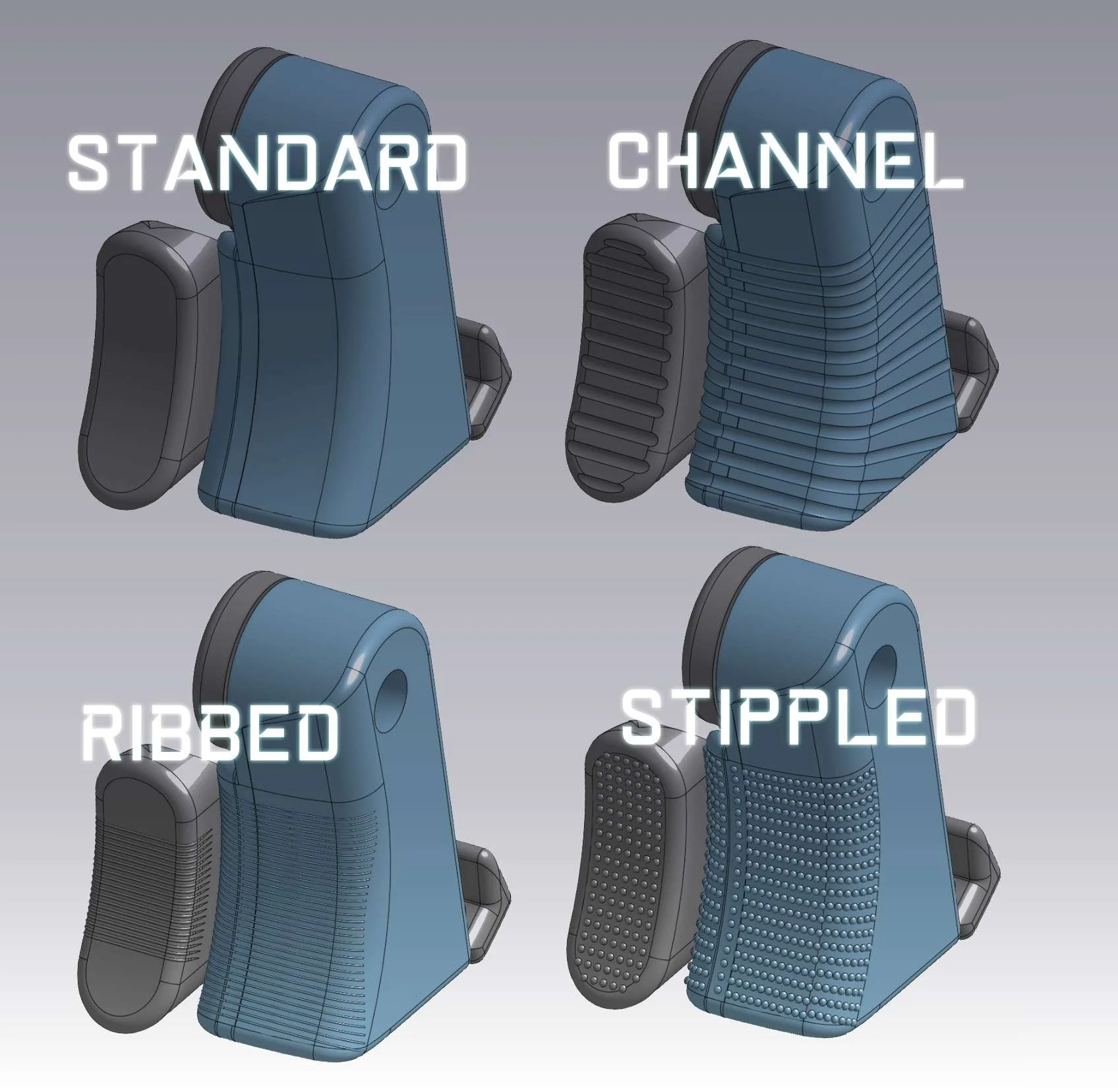
And the cherry on top is customization. Users of V3 have their choice of 4 different textures for the Primary and Secondary triggers as well as 3 options for the Forward trigger spacing. This ensures that regardless of who uses it, there will be an option that appeals to them.
a new challenger
Following the success of the VKB V3, the constant question was:
“Do you make this for x joystick?”
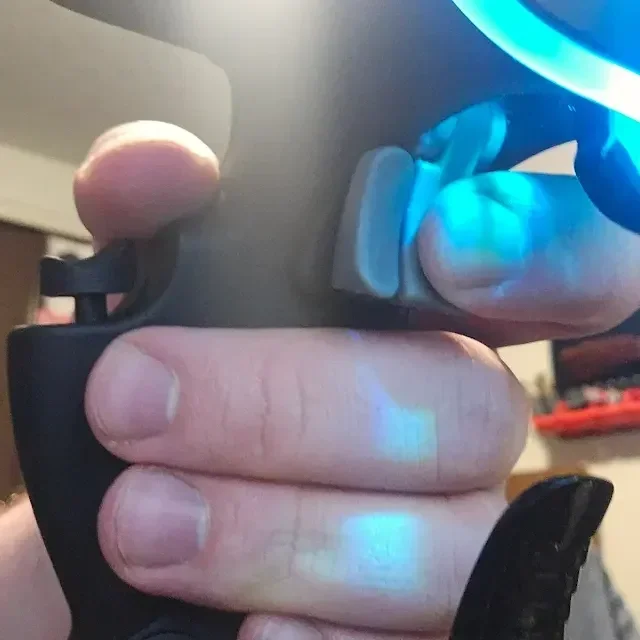
So began the work of bringing the concept to other models of stick. Starting with the Virpil Constellation Alpha, I’ve worked to bring this trigger design to market.
However, the Virpil has a flip-down trigger that uses the base trigger for its activation. Due to its length, it didn’t feel right to use an extended trigger paddle. So instead, I developed the Sidecar variant. This still allows the simultaneous and selective activation of the 2 stage trigger. But it has the bypass mounted to the side. For joysticks like the Virpil, this is the perfect solution.